
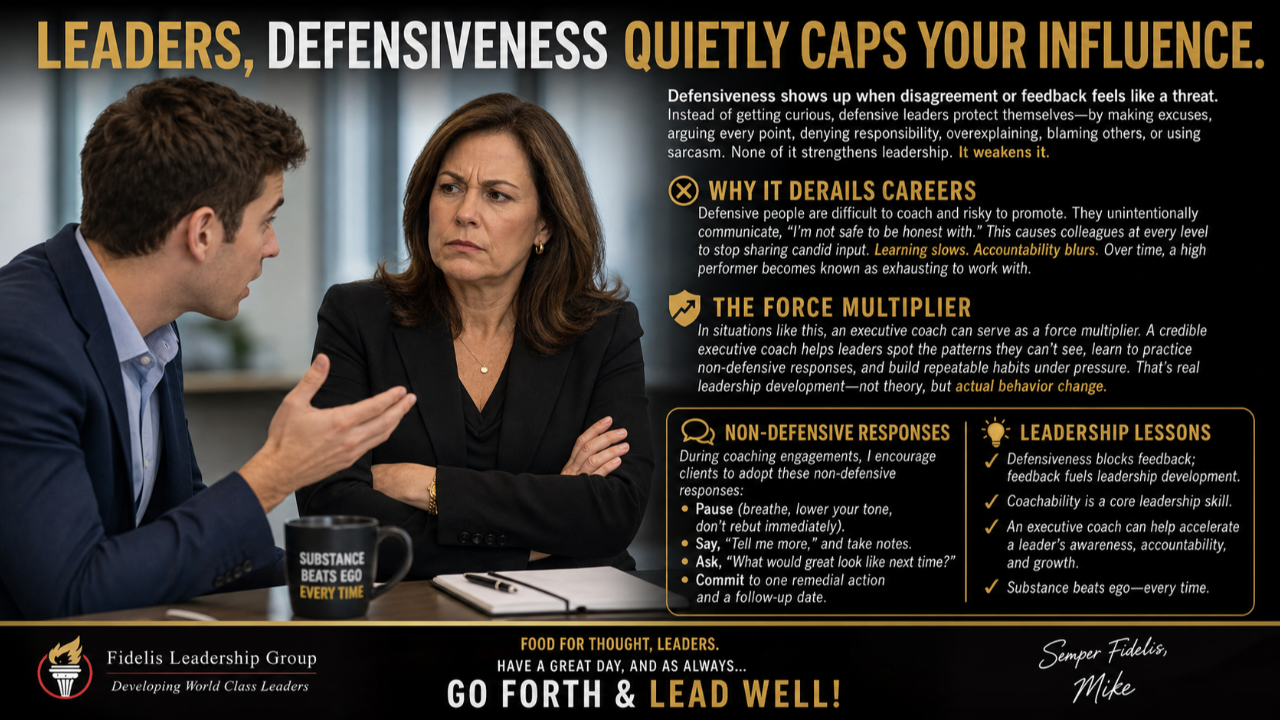
Leadership Development: How Defensiveness Quietly Caps Your Influence and Growth
Leaders,
As your responsibilities grow, there’s one trait can quietly cap your influence, credibility, and promotability: defensiveness.
Defensiveness shows up when disagreement or feedback feels like a threat.
Instead of getting curious, defensive leaders protect themselves—by making excuses, arguing every point, denying responsibility, overexplaining, blaming others, or using sarcasm.
None of it strengthens leadership. It weakens it.
Why it Derails Careers
Defensive people are difficult to coach and risky to promote. They unintentionally communicate, “I’m not safe to be honest with.” This causes colleagues at every level to stop sharing candid input.
Learning slows.
Accountability blurs.
Over time, a high performer becomes known as exhausting to work with.
The Force Multiplier
In situations like this, an executive coach can serve as a force multiplier. A credible executive coach helps leaders spot the patterns they can’t see, learn to practice non-defensive responses, and build repeatable habits under pressure. That’s real leadership development—not theory, but actual behavior change.
During coaching engagements, I encourage clients to adopt these non-defensive responses:
- Pause (breathe, lower your tone, don’t rebut immediately).
- Say, “Tell me more,” and take notes.
- Ask, “What would great look like next time?”
- Commit to one remedial action and a follow-up date.
Leadership Lessons:
- Defensiveness blocks feedback; feedback fuels leadership development.
- Coachability is a core leadership skill.
- An executive coach can help accelerate a leader’s awareness, accountability, and growth.
- Substance beats ego—every time.
Food for thought, Leaders.
Have a Great Day, and as always…
Go Forth & Lead Well!
Semper Fidelis,
Mike
